
There’s a lot of curiosity—and sometimes a little confusion—about how people who eat plant-based get enough protein. Yet plant-powered eating is anything but new. However, “Plant-based lifestyles have been around for centuries,” says Cory Davis, a government environmentalist and agrologist. “Buddhist monks, Taoists, Sikhs, Seventh Day Adventists, and many others with diverse cultural backgrounds were practising predominantly plant-based eating successfully before it ever became mainstream in today’s North America.
“When we look back at our early ancestors, diets were almost entirely plant-based for the first 80 per cent of the Paleolithic period and were still plant-heavy thereafter. Henry David Thoreau in his book Walden, back in the 1850s, predicted that humanity would slowly transition away from eating animals. Many others have done the same.
“As we continue to increase our circle of empathy, recognize the importance of health, and reconnect with the ecosystems that sustain us, a natural progression to a plant-based agricultural system is a clear path toward our goals.
Plant-based eating, Davis stresses, is here to stay. “Rather than being a fad, it is the logical way forward for modern society.” “The vegan boom is driven by decades of solid scientific evidence that supports its health, environmental and ethical advantages.”
Americans who identify as vegetarian or vegan now make up at least 6 percent of the population, and possibly 10 to 15 percent, according to recent surveys. Three household in five go meatless at least sometimes, a sharp break from meat-and-potatoes tradition. In Canada, about 7% are vegetarian and 2% are vegan, and a bigger shift is towards adding plant-based proteins and other options, according to Agriculture and Agri-Food Canada and the Canadian Agri-Food Policy Institute (CAPI).
A Book That’s Changing the Protein Conversation
Registered Dietitians Brenda Davis and Vesanto Melina, along with Brenda’s son Cory, co-authored the book Plant Powered Protein, which reached #1 on amazon in the sustainability category. Together, Dietitians Davis and Melina have co-authored 14 books, boasting more than a million copies in print in English and translated into 9 other languages. Their latest work takes on one of the most persistent questions in plant-based nutrition: Are plant proteins really good enough? The answer, backed by decades of research, is a resounding yes.
In addition to sound nutrition information, it has great recipes!
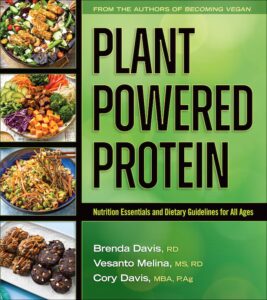
“We explored the myths surrounding animal-versus-plant protein and the weight of evidence that quickly puts these myths to rest,” Melina explains. “We had long been frustrated with the politics of protein and the subsidies that heavily favour the animal protein industries. We reflected on the common narrative around animal protein being of ‘higher quality’ than plant protein, when in fact all the essential amino acids are derived from plants, and plant-based diets are not short of these!. The time has come to redefine protein quality by weaving in its impacts on risk of death, risk of disease and on the environment.”
The book uses scientific studies, tables, charts and in-depth nutritional analyses to break down the topic of protein and plant-based eating for a variety of diets. “Plant Powered Protein is for everyone who wants to improve the quality of their diet and reduce their risk of chronic disease,” Brenda says. “It is for all those striving to minimize their dietary environmental footprint. It is for people who wonder if it is possible to get enough protein from plants during pregnancy and lactation, for growing children, for seniors and for competitive athletes. We require about 10 to 15 percent of our calories from protein in a calorically adequate diet. This shows the percent calories from protein in various food groups.
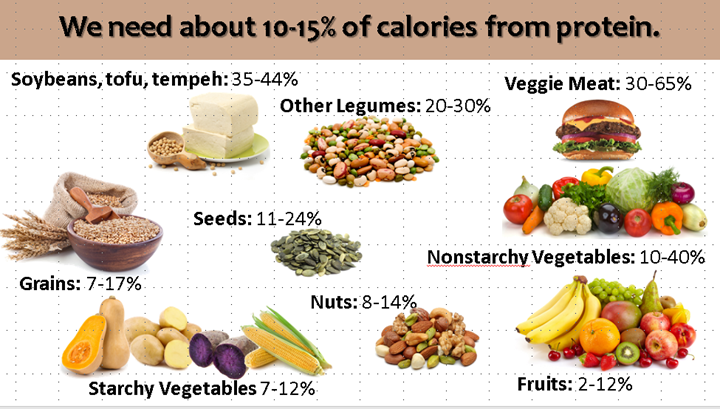
Those shown at the top—the soyfoods, legumes (bean, peas, lentils, peanuts) and the veggie meats provide similar amounts of protein to animal products. Globally, grains provide about half (47-50% of the world’s protein. Seeds can be significant contributors, with hemp seeds at the high end of the range. All whole plant foods contain protein and all contain every one of the nine essential amino acids. The group that is particularly low in protein is Fruits. Their contribution is their abundance of vitamins and protective phytochemicals.
When I do nutritional analysis of client’s diets, I find a few that are low in protein, though not many. And whether the clients are parents, children, seniors, or top athletes we quickly create menus that appeal to those individuals, and are simple and delicious.